From a founder's idea to a live marketplace, designed and built end to end.
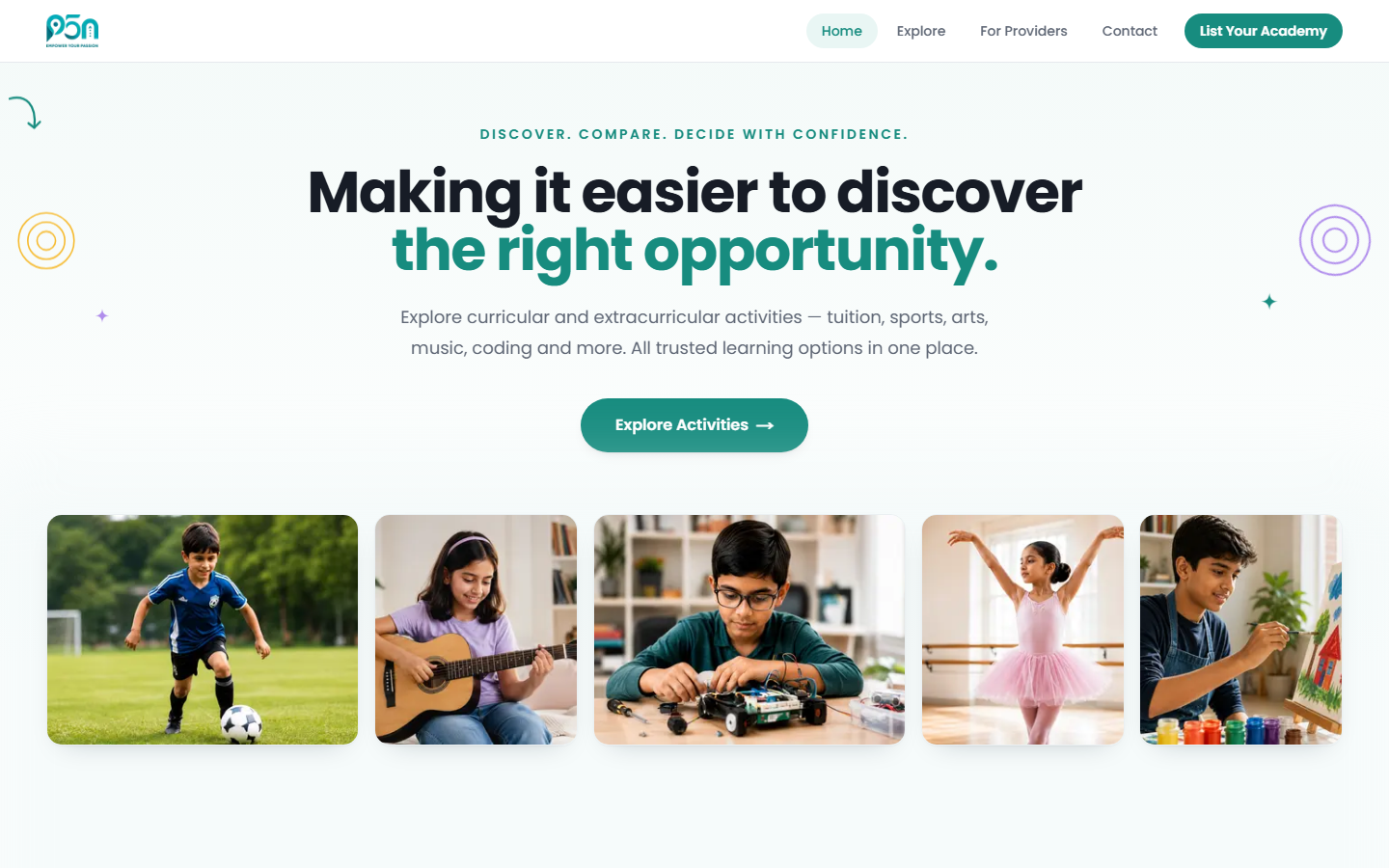
Parents in Gujarat search Google, WhatsApp groups and Instagram to find classes for their kids. p5n puts trusted tuition, sports, arts and coding providers in one place. The work covered product definition, every flow, and the full build with AI.
Open p5n.in ↗- Problem
- Parents have no single place to compare trusted classes, and most providers are offline.
- Role
- End to end. Product definition, UX, UI, the full build and the field-team operation.
- What shipped
- Parent discovery app, internal admin, and tools for a field onboarding team.
- Result
- Live at p5n.in, with a field team onboarding real providers who approve their own listings.
- Platform
- Mobile-first web app + desktop admin
- Engagement
- Designed & built
- Scope
- Product strategy · UX architecture · UI design · Full-stack build · Ops design
- Idea to production on p5n.in
- 0 → live
- Product and engineering decisions written down
- 40+
- Surfaces — parent app, admin, field-team tools
- 3
Context
What was in the way
- Parents rely on word of mouth, scattered Instagram pages and WhatsApp forwards. There's no single place to compare options they can trust.
- Activity providers in Indian cities are mostly offline. They don't self-onboard, so the supply side has to be built by hand.
- A small team can't afford a separate designer, PM and developers for an unproven idea.
- A small budget and no separate design, product or engineering team
- Providers are mostly offline and won't sign up on their own
- Parents decide on their phones; the internal team curates at a desk
- Trust had to come first. One fake-looking listing undermines the rest
The bet
If discovery is easy and every listing is real, parents will enquire. Prove that before building payments or booking.
Key decisions
The calls that shaped it
Each one with the reasoning, and what was deliberately left out. The screens follow from these.
- Decision 01Accepted
Discovery and leads first. No payments, no booking.
WhyThe riskiest question was "will parents enquire?", not "will they pay online?". Cutting booking, chat and subscriptions got a real product live months earlier.
Not donePayments, booking and subscriptions, which wait until demand is proven.
- Decision 02Accepted
Mobile-first for parents, desktop-first for the admin
WhyParents browse on phones between school runs. The internal team curates hundreds of records at a desk. Two audiences, two deliberate layouts, one codebase.
Not doneOne responsive layout stretched to fit both.
- Decision 03Accepted
Providers are onboarded by people, not a sign-up form
WhyMost providers would never fill a form. A field "onboarder" program replaced it, with a lead list, per-person tracking, a one-time approval link emailed to the provider, and weekly pay based on approvals.
Not doneA self-serve provider portal, which moved to the next phase.
- Decision 04Accepted
Real provider photos only, never stock
WhyTrust is the product. Featured placement needs real imagery, so a listing that looks good is also one that's genuine.
Not doneStock photos to make empty listings look full.
- Decision 05Accepted
Every listing has a lifecycle — Draft, Review, Published, Hidden, Archived
WhyOnly approved providers reach parents. Bad data is prevented at entry, not cleaned up later.
Artifacts
From the working documents
In
- Discovery: curricular and extracurricular
- Search and area filters
- Provider profiles with batches and fees
- Lead capture
- Ratings
- Internal admin
Out, for now
- Online payments
- Booking
- Chat and notifications
- Provider self-registration
- Subscriptions
- AI recommendations
Every cut item answers a later question. None of them answers "will parents enquire?", so they wait.
Parent · mobile
- Home
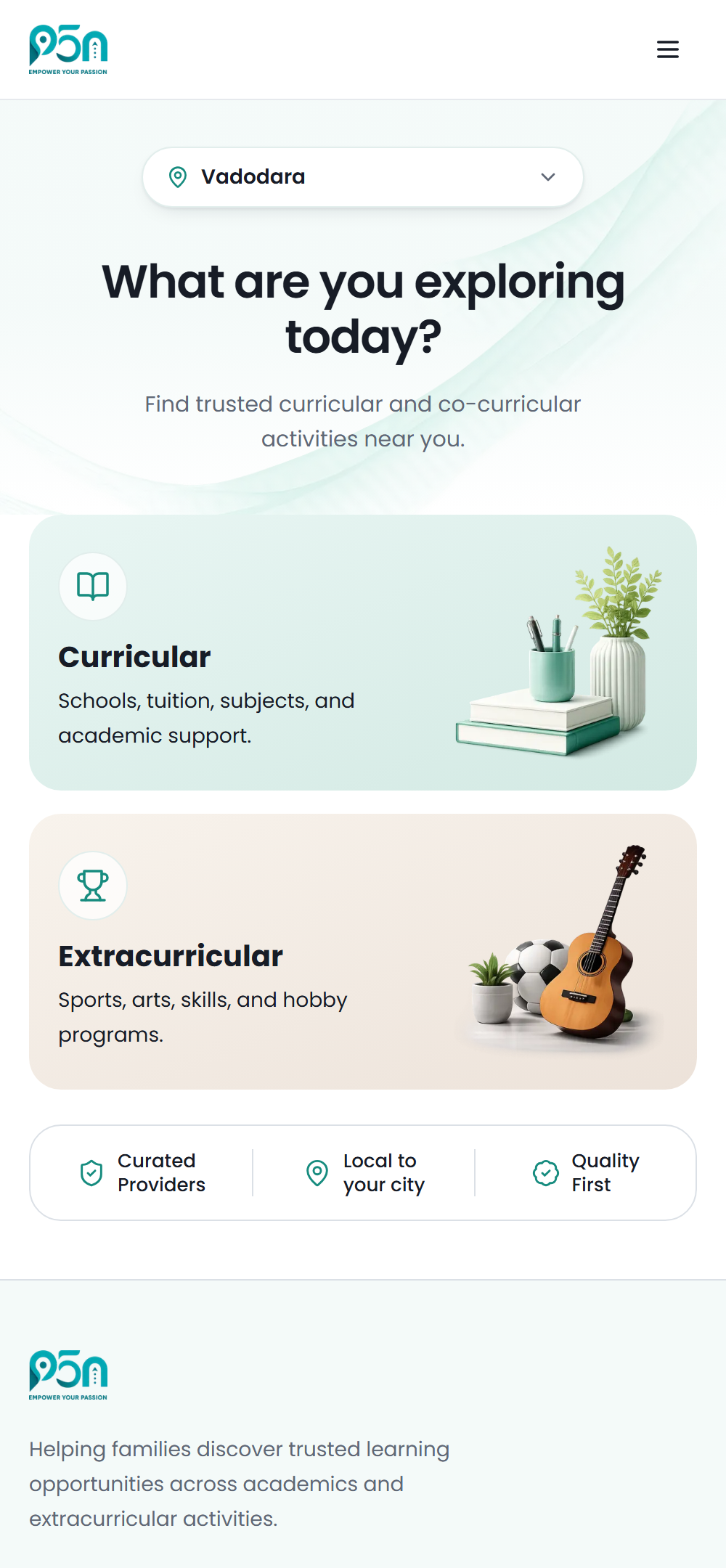
- Curricular or extracurricular?
- Discover by area and activity
- Provider profile
- Enquire
Provider · field team
- Onboarder adds the lead
- Builds the profile
- Sends a one-time approval link
- Provider approves
- Published
The story
Starting point
The founder’s insight was simple. Every parent in Vadodara asks “where should my child learn this?”, and answers it badly, through WhatsApp forwards and luck.
The work didn’t start in Figma. It started with a product context document: the vision, who it’s for, what’s in the MVP and, more importantly, what’s out. That document became the brief for every design and build decision after it. It’s also what kept the AI coding tools on track.
Designing and building in one loop
The product moved in short loops: a flow, a working screen, a review on a real phone, a fix. With design and code in the same hands, design intent never got lost in a handoff.
The hardest design problem wasn’t a screen. It was the supply side: how do you get offline providers onto a platform?
Designing the operation, not just the app
Marketplaces die on the supply side. So the product grew a third surface: tools for a field team who visit providers, add leads, and send each provider a one-time link to approve their own profile. Pay is tied to approvals and counted on the server, so nobody argues over spreadsheets.
This is where UX, operations and the business model meet, and where a marketplace actually wins.
The product
What it looks like
Outcome
Where it landed
- Live at p5n.in with public discovery, provider profiles and lead capture
- A full internal admin for providers, locations, activities, batches, media, leads and ratings
- A field onboarding team using role-based tools in production, with real providers approving their own listings
- Production hardening done before ad spend — bot protection, rate limiting, error monitoring, row-level security
A provider portal so providers manage their own listings, then booking and payments once demand is proven.
What this means for your product
You don't need a full team to find out if your idea works. You need someone who can make the product calls and ship the result.
Talk about your product →